Why Low Back Stretches Should Start at the Backs of Your Thighs
Cedars-Sinai calls the hamstrings and glutes the most important muscles to stretch for low back pain, because both connect to the pelvis and lower spine. Hold a static stretch for about 30 seconds, the hold time named in three of the five rows of the sources' table.
Stretch the backs of your thighs and your buttocks first.
Those are the hamstrings and glutes. Cedars-Sinai calls them the most important muscles to stretch for low back pain. Hold a static stretch for about 30 seconds, which is the hold time the sources below name most often. The Cedars-Sinai hamstring glide is different and uses 5-second holds.
If you sit all day, add a standing back bend about every hour, unless you have spinal stenosis.
When to see a clinician before you stretch. Cedars-Sinai says to see a doctor if your pain is acute, lasts more than a few days, or comes with weakness or numbness. MedlinePlus says to call your health care provider if back pain is severe or has not improved after three days.
Hamstrings and glutes are the muscles Cedars-Sinai calls most important
Cedars-Sinai describes the hamstrings and gluteals as “two big muscle groups that connect to your pelvis and lower spine.” It calls them the most important muscles to stretch for low back pain. So a stretch that looks like a leg stretch is also aimed at the low back.
Starting with them is this page’s choice. Cedars-Sinai’s own list starts with knees-to-chest.
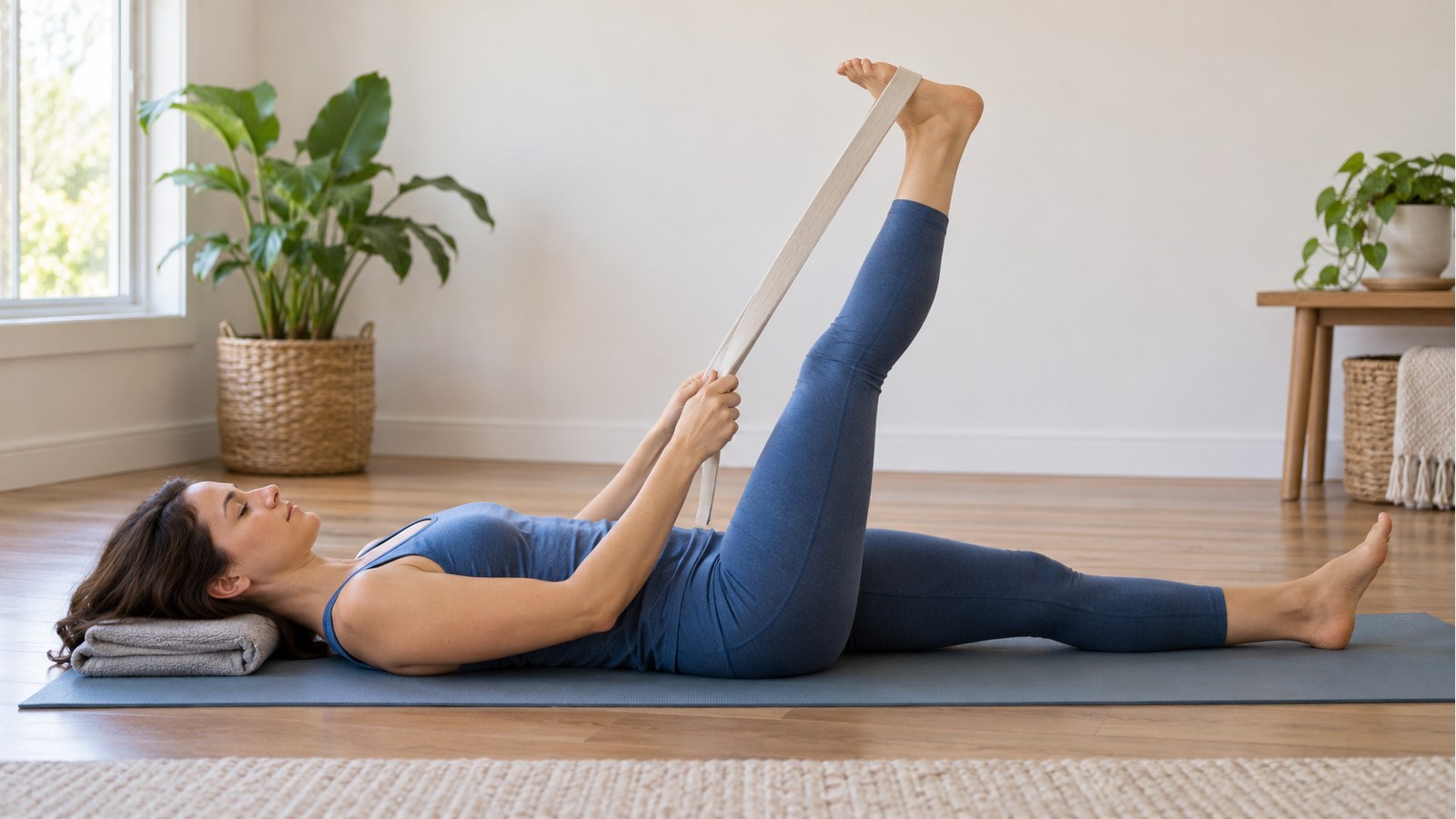
For the hamstrings: the supine neural glide. Cedars-Sinai gives these steps:
- Lie on your back with your legs out straight.
- Pull one knee toward your body and hold behind the knee.
- Straighten that leg until you feel a stretch in the back of your thigh.
- Flex your foot toward you as you feel the stretch.
- Hold for 5 seconds, then relax the leg briefly.
For the glutes: knee-to-chest, one leg at a time. Healthline says this stretch relaxes your hips, thighs and glutes. The steps:
- Lie on your back with your knees bent and your feet flat on the floor.
- Keep your left knee bent, or stretch that leg out along the floor.
- Draw your right knee into your chest, with your hands behind your thigh or at the top of your shinbone.
- Keep your spine long down to your tailbone, and keep your hips on the floor.
- Hold for 30 seconds to 1 minute, then switch legs.
The sources disagree on how long to hold a stretch. Here they are side by side:
| Source | Stretch | Hold and repeats |
|---|---|---|
| Cedars-Sinai | Knees-to-chest, lying on your back | At least 30 seconds |
| Cedars-Sinai | Supine neural glide (hamstrings, lying on your back) | 5-second holds |
| Healthline | Knee-to-chest | 30 seconds to 1 minute |
| Pierce Chiropractic | Stretches done one leg at a time | 20 seconds, 3 times per leg |
| Ability Rehabilitation | Its stretches in general | At least 10 seconds, with 30 seconds ideal |
Three of the five rows name 30 seconds. That makes 30 seconds the hold time with the most agreement. The neural glide is the exception, with short 5-second holds.
Skip the toe touch if you have a disc problem. For a herniated disc, HSS says “too much stretching in a forward position—like touching your toes—is not advised.” Instead, HSS points to stretches that “comfortably extend and maintain your spine in a neutral position.” The standing back bend in the next section comes from that same HSS disc advice. Knees-to-chest also bends you forward, so the same caution applies to it.
If any stretch sends nerve symptoms down your legs, HSS says to find one that works better or do less of it.
Desk workers: one standing back bend about every hour, unless you have stenosis
This stretch has a catch, and HSS states it on the same page. With spinal stenosis, “movements that extend the spine, such as bending backwards, can aggravate the symptoms.” Spinal stenosis is a narrowing of the spaces inside the spine. If you have it, skip this stretch.
HSS points people with stenosis toward neutral or forward-bending stretches instead. Knees-to-chest, from the table above, bends the spine forward.
HSS recommends the standing lumbar extension about every hour at work to ease strain on the lower back. The steps:
- Stand tall and rest your palms on your hips.
- Lean back and let your low back arch, using your hands to help the motion.
- Hold for 5 seconds.
- Repeat, up to 10 times a day.
You can do it next to your desk without lying down or changing clothes. That makes it the easiest stretch on this page to fit into a workday.
How often: three sources, three separate schedules
The sources describe different routines, not one shared plan. Pick the one that fits your day:
- At work: HSS’s standing back bend, about every hour.
- In the morning: Pierce Chiropractic recommends a few minutes of low back stretching every morning.
- As a daily set: Healthline says its lower back stretches can be done once or twice a day.
If you sit for work, the hourly back bend is the easiest to keep up, because it needs no floor space. If you don’t, the morning few minutes or Healthline’s set may suit you better.
Stop when a stretch sends symptoms down a leg, causes shooting pain or leaves you very sore
Three sources name three different stop signs:
- HSS warns you to watch for any stretch that sends nerve symptoms down the legs or makes the pain worse.
- Ability Rehabilitation says to never do an exercise or stretch that causes shooting pain or extreme discomfort.
- Healthline suggests taking a day off from stretching if the pain gets worse or you feel very sore.
The first two tell you to stop that stretch right away. The third tells you to skip your next session.
Pair stretches with strengthening: NIAMS links weak back and stomach muscles to back pain
NIAMS, part of the US National Institutes of Health, lists fitness level as a risk factor for back pain. It notes that weak back and stomach muscles may not support the spine properly.
An HSS physical therapist makes a related point in HSS’s advice on herniated discs: “counterbalance the stretching with strengthening to build up the muscles around the affected disc.”
Stretching and strengthening do different jobs, and HSS advises balancing one with the other. The HSS page includes exercises along with its stretches. A physical therapist can tell you which ones fit your back.
Day by day: no more than two days in bed, a call by day three if no better
This timeline puts the timing rules from two sources in one order. Items 2–4 are deadlines. When you reach one, deal with it before you go back to your stretching routine.
- Days 1 and 2 of a flare-up: if you rest in bed, keep it short. MedlinePlus says staying in bed for more than 1 or 2 days can make back pain worse.
- From the first day: acute pain, or any weakness or numbness, is a reason to see a doctor, per Cedars-Sinai. Severe pain is a reason to call your health care provider, per MedlinePlus.
- After a few days: Cedars-Sinai says pain that is still there is a reason to see a doctor.
- Day 3: if the pain has not improved, MedlinePlus says to call your health care provider.
- Month 3: MedlinePlus calls back pain chronic once it lasts more than three months.
For more on this topic, see the Relief and movement guides.
Related reading: Lower Back Aching; Lower Back Pain Exercises.
FAQ: for hip and low back pain, start with the muscles at the pelvis
How do I relieve hip and lower back pain? Start with the hamstrings and glutes. Cedars-Sinai notes that both connect to the pelvis and the lower spine. Knees-to-chest and the lying hamstring glide from the table are two places to begin. One caveat: knees-to-chest bends the spine forward, and for a herniated disc HSS says too much forward stretching is not advised. No stretch promises relief, and the stop signs above still apply.
How long should I hold each stretch? About 30 seconds for a static hold like knees-to-chest. Three of the five rows in the table name that figure. The Cedars-Sinai hamstring glide is the exception: hold for 5 seconds, then relax the leg briefly.
When should I see a clinician instead of stretching? Use the box at the top of this page and items 2–4 of the timeline. If you reach any of those points, call a health care provider before your next stretching session.
This page is general information drawn from the health sources linked on it. It is not medical advice.
Sources
- https://www.cedars-sinai.org/stories-and-insights/expert-advice/the-best-stretches-and-exercises-for-lower-back-pain
- https://www.healthline.com/health/lower-back-stretches
- https://www.hss.edu/health-library/move-better/exercises-for-lower-back-pain
- https://medlineplus.gov/backpain.html
- https://www.niams.nih.gov/health-topics/back-pain
- https://abilityrehabilitation.com/news/6-easy-stretches-to-reduce-back-pain/
- https://www.piercechiropractic.net/blog/six-stretches-to-help-alleviate-low-back-pain-and-tightness