Physical Therapy Treatment of Sciatica: Your Cause Picks the Exercises
Physical therapy for sciatica is matched to its cause, and one clinic stages it as decompression, then nerve glides, then strength. For back pain in general, MedlinePlus says to call a provider if pain is severe or not better after three days.

In physical therapy treatment of sciatica, the cause picks the exercises.
So no single routine fits everyone. This page covers what a physical therapist (PT) may use, and how a movement exam matches exercises to your cause. Then it walks through one clinic’s home order: decompression first, nerve glides second, strength third. That order comes from the Limitless clinic’s page. It is not a rule every PT follows.
If your back pain is severe or follows an injury, contact a provider first. The sources for each sign are in the section on calling sooner.
Sciatica Is a Set of Symptoms, Not One Condition
Sciatica is the name for a pattern, not a single problem. Calibration PT, a physical therapy clinic, calls it a group of symptoms from an irritated sciatic nerve. The irritation can sit anywhere from the lower back down into the leg.
The pattern also differs between people. Per the same clinic, sitting may be the worst time for one person, walking or bending for another.
That difference matters. Calibration PT says the pattern “provides valuable clues about what’s causing the irritation.” Note which positions bother you most, and bring that to a first PT visit.
A PT May Combine Manual, Soft Tissue and Exercise Work
A session is often more than exercise. Spine-health’s sciatica physical therapy page is credited to Kate Blankshain, PT, DPT (a physical therapist with a Doctor of Physical Therapy degree). It says a therapist may prescribe “a combination of various types of physical, manual, soft tissue mobilization, and/or exercise therapies.”
In plain terms, in manual therapy the therapist moves your joints or tissues with their hands. Soft tissue mobilization aims that work at muscles and the tissue around them. Exercise therapy is the movement work itself. At the Limitless clinic, the plan pairs hands-on work with “a short daily exercise set.”
Ask which of these your plan includes, and why. The answer should trace back to what your exam found.
The First Days: Keep Moving Instead of Staying in Bed
Bed rest feels like the careful choice, but the sources lean against it. GSPP Rehabilitation, a rehab clinic, says a few days of resting in bed can be counterproductive for sciatica.
MedlinePlus says something similar about back pain in general: more than 1 or 2 days in bed can make it worse.
The movement can stay modest. The Limitless clinic counts walking from day one. If walking is what hurts most, tell your PT. That is the kind of difference Calibration PT describes.
A Movement Exam Matches Exercises to Your Cause
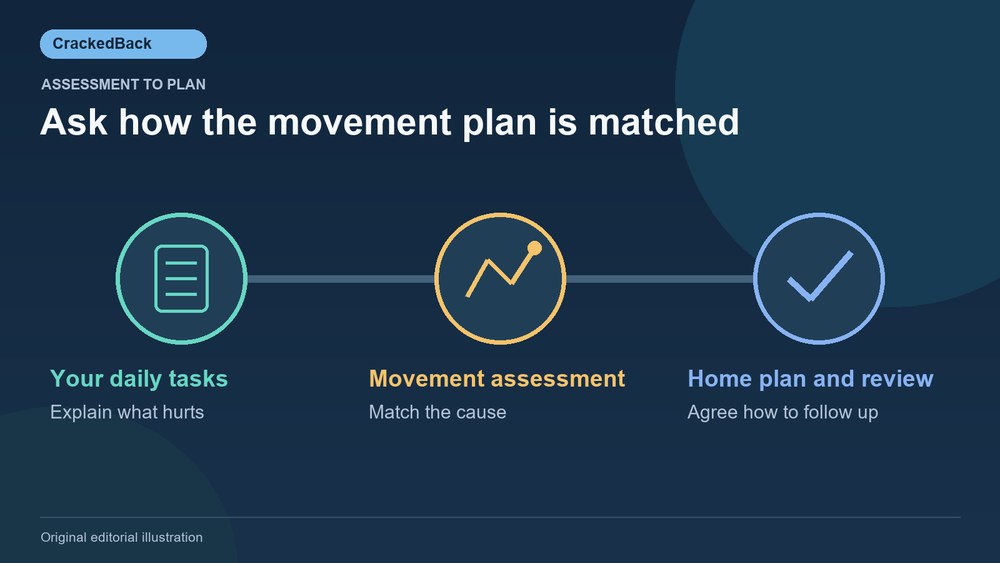
The Limitless clinic says an exercise that helps one person “can actually make another person’s pain worse.” So its first visit is a movement exam. The exam looks for “which direction and which positions ease your leg symptoms,” and the clinic says “that answer decides everything that follows.”
In practice, that exam is how your cause gets matched to exercises. Calibration PT describes the same approach: physical therapy looks at how your symptoms behave and respond to movement, not at imaging alone. Both fit Spine-health’s point that the cause sets the exercises.
One Clinic’s Home Order: Decompression, Then Nerve Glides, Then Strength
For home exercise, the Limitless page stages the work like this:
- Decompression (positions that take tension off the nerve). In the first few days, the clinic uses the 90/90 position and a prone progression. In the 90/90 position you lie on your back, hips and knees bent at right angles. The prone progression goes from lying on your stomach, to your elbows, to press-ups.
- Nerve glides. These gentle movements of the nerve along its path come second, once lying flat is comfortable.
- Strength. The clinic names dead bug, bird dog, glute bridge and clamshell.
Who should skip this order: if a PT has already built your plan from an exam, follow that plan instead. Limitless builds its own patients’ plans that way.
The same page also lists stretches the clinic avoids, including the classic hamstring stretch. If a routine you find elsewhere starts at the backs of the thighs, ask your PT how it fits your cause.
Stop Any Exercise That Sends Pain Further Down the Leg
The clinic’s stop signal is plain. If an exercise makes pain travel further down your leg, stop and tell your physical therapist. HSS gives a broader rule for its home moves: they shouldn’t cause more pain, and “if they do, stop right away.”
To use the clinic’s rule, you need a starting point. Before you exercise, note where the pain reaches. GSPP lists the most common spots as the low back, buttock, back of the thigh or calf. If an exercise pushes it lower, that is the one to stop and report.
A short daily note of that spot gives your PT a record. It is easier to judge than memory.
Call Sooner for Severe Pain or Back Pain After an Injury
Some signs should not wait for the exercise order. MedlinePlus says to get medical attention for back pain after an injury. GSPP Rehabilitation notes that severe cases of sciatica can bring leg weakness and bowel or bladder changes.
Two time limits apply, and the shorter one comes first. MedlinePlus says to call a provider if back pain is severe or not better after three days. For sciatica, the Hospital for Special Surgery (HSS) advises a doctor visit once symptoms last “more than a week or two.” Act on the three-day check first; don’t wait for the HSS mark.
If your plan stalls, don’t just repeat it. Ask about the next step. HSS says that when physical therapy is not enough, your PT can refer you to a sciatica specialist.
See also: low back pain causes, and when to stop waiting.
Day One to Three Months: The Three-Day Call Can Come Before Decompression Ends
None of these pages gives a full schedule. Put side by side, they make one, and item 3 shows where two of them overlap.
- Day one: walking counts from day one in the Limitless plan. For back pain in general, MedlinePlus puts the bed-rest limit at 1 or 2 days.
- First few days: decompression, using the 90/90 position and the prone progression.
- Day three: for back pain in general, MedlinePlus says to call a provider if pain is severe or not better. That can fall inside the clinic’s “first few days” of decompression. Make the call without waiting for the sequence to finish.
- When lying flat is comfortable (no set day): add nerve glides.
- After the glides: start the strength work, the clinic’s third stage.
- Any day: if pain travels further down the leg, stop that exercise and tell your PT.
- After a week or two: the HSS doctor check for sciatica that hasn’t eased.
- If PT is not enough: ask your PT for the specialist referral HSS describes.
- Past three months: MedlinePlus calls back pain chronic once it lasts more than three months.
Next step: for the general checkpoints on day-to-day back aches, read lower back aching: the 3-day and 1-week checkpoints.
FAQ: What Are the Treatment Options for Sciatica Nerve Pain?
What Can Be Combined With Physical Therapy?
Spine-health says physical therapy “may or may not be combined with” pain-relieving options. Its examples are over-the-counter or prescription medicines and epidural steroid injections (steroid shots into the space around the spinal nerves). The page presents these as add-ons to physical therapy, not replacements for it. Whether you need one is a choice to make with a clinician.
Is Chiropractic Care an Option?
Spine-health lists chiropractors among the clinicians who specialize in radiating lower back pain, along with physical therapists. Per the National Center for Complementary and Integrative Health (NCCIH), chiropractic care typically involves manual therapy, often spinal manipulation. NCCIH reports that 11.0 percent of U.S. adults, about 1 in 9, used it in 2022. Of those users, 85.7 percent went for pain management. Both figures cover all adults and all kinds of pain, not sciatica alone. For the research on that method, see what NIH says about spinal manipulation for back pain.
Who Should I Contact First?
Two sources put physical therapy first. Spine-health calls physical therapy and exercise “typically first-line treatments” for sciatica symptoms. GSPP Rehabilitation says physical therapy “is usually the best treatment for sciatica.” Start with a PT, or with your usual health care provider, the contact MedlinePlus names for its time limits. Bring your notes on where the pain reaches and which positions make it worse. If any sign from the section on calling sooner appears, or the pain is not settling, contact a provider before you start or continue any exercise on this page.
Not medical advice. This page sums up public health sources and clinic pages.
Sources
- https://calibrationptkc.com/blog/role-of-pt-in-sciatic-pain-treatment
- https://www.spine-health.com/conditions/sciatica/physical-therapy-and-exercise-sciatica
- https://limitlesspts.com/sciatica-exercises-physical-therapy/
- https://pennrehab.org/how-physical-therapy-can-help-sciatica-lower-back-pain/
- https://medlineplus.gov/backpain.html
- https://www.hss.edu/health-library/move-better/sciatica-stretches
- https://www.nccih.nih.gov/health/chiropractic-in-depth