Pain in Your Lower Left Back: Muscle, Spine or Organ? The Clues for Each
Most often it's muscle: five of six health sources that name a top cause point to a strained muscle or other soft-tissue injury. Only Johns Hopkins puts spine arthritis first, and organ causes such as a kidney infection bring their own signs, like fever.
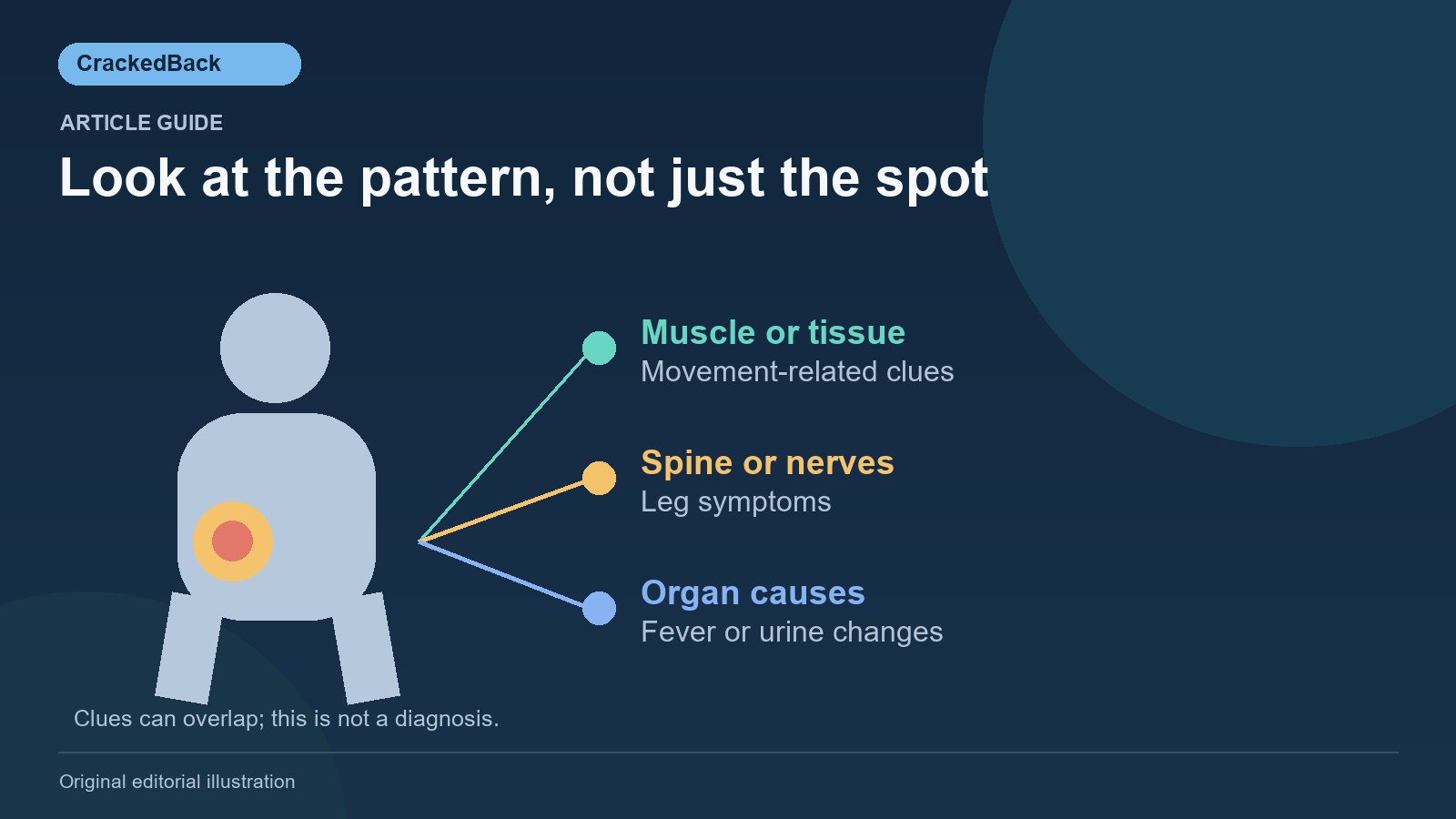
Usually it’s a strained muscle or another injury to the back’s tissue. The two pages below that name a top cause for pain in lower left back specifically, Mandaya Hospital Group and FYZICAL, both say so. No page puts an organ cause first, and only one puts the spine first.
When to get help now: If back pain comes with loss of bladder or bowel control, get help right away. The University of Maryland Medical System (UMMS) says to go to a local emergency room; Spine-health says it “requires immediate medical attention.”
Lower Left Back Pain Can Be Sharp, Dull or Tender to the Touch
Orthopedic surgeon Lawrence Alexander, MD, writes in a Spine-health guide that lower left back pain can be “severe, sharp, and stabbing” or “a dull but constant ache.” Some of it changes as you move, and some hurts when pressed.
The way it feels is a clue, not an answer. Write down when it started, what makes it worse and whether anything else in your body has changed. Bring those notes to any visit.
The Most Common Cause: A Strain or Tissue Injury, Most Sources Say
The table puts seven pages side by side. Six name a most common cause: five pick a strain or tissue injury, and one, Johns Hopkins, picks spine arthritis. Only Mandaya and FYZICAL say it of left-side pain; the other four speak of lower back pain in general.
| Source | Most common cause it names | Left side or all low back? | Its wording |
|---|---|---|---|
| Spine-health | Strained muscle or ligament | All low back | “Most cases” |
| Medical News Today | Tissue injury: muscles, bones, ligaments | All low back | “In most cases” |
| Mandaya Hospital Group | Tissue injury: muscles, bones, ligaments | Left side | “In most cases” |
| FYZICAL | Overused or strained muscle | Left side | “In most cases” |
| Cleveland Clinic | Injury to muscles or tendons | All low back | “Most often” |
| Johns Hopkins | Spine arthritis | All low back | “the most frequent cause” |
| UMMS | None named | — | — |
Keep two limits in mind when you read the count. It tallies web pages, not patients, so it can’t tell you how often each cause happens. Also, Mandaya’s wording closely mirrors Medical News Today’s, so those two rows may not be independent views.
Spine Causes: Hopkins Names Arthritis, Medical News Today Adds a Slipped Disk
Johns Hopkins calls arthritis of the spine, “the slow degeneration of the spinal joints,” the most frequent cause of lower back pain. It also notes that your lower back usually has just five vertebrae, the stacked bones of the spine. That’s fewer than your neck or mid-back has, and those five carry the weight of your upper body.
A slipped disk can send pain to one side, according to Medical News Today in a page medically reviewed by Darragh O’Carroll, MD. In a slipped disk, soft material inside one of the spine’s cushioning disks pushes through a tear and presses on nerves. FYZICAL also lists the sacroiliac (SI) joint, where the base of the spine meets the pelvis.
Organ Causes Come With Their Own Signs: Fever, Urine Changes, Belly Pain
Left-sided pain can start in the kidneys, pancreas, colon or uterus, according to Medical News Today (updated April 8, 2025). Mandaya Hospital Group lists the signs that come with several of these:
- Kidney infection: fever, chills, nausea, frequent or painful urination, and dark, cloudy or bloody urine.
- Kidney stones: pain during urination, nausea, fever and blood in the urine.
- Pancreatitis, inflammation of the pancreas: pain in the upper belly that spreads to the back.
- Endometriosis, where uterine tissue grows outside the uterus: one-sided pain that comes and goes, with severe menstrual cramps.
Muscle, Spine and Organ Causes Point to Different Clues
Stiffness and reduced movement show up under both a muscle strain and arthritis, so no single clue settles the cause. The pattern of clues still helps you describe your pain at a visit.
| Group | Possible cause | Clues the sources name | Source |
|---|---|---|---|
| Muscle | Strained muscle | Stiffness, spasms, limited range of motion, pain that may worsen getting out of bed; heavy lifting, twisting or a fall can cause it | Medical News Today |
| Muscle | Strained muscle or ligament | Heals within a few days or weeks, though the pain may be severe | Spine-health |
| Spine | Slipped disk | Tingling down one leg; pain on one side | Medical News Today |
| Spine | Arthritis | Stiffness, swelling, reduced range of motion | Mandaya Hospital Group |
| Spine | SI joint | A deep ache in the buttock or back of the hip | FYZICAL |
| Organ | Kidney, pancreas or uterus | Fever, chills, urine changes, upper-belly pain or severe menstrual cramps | Mandaya Hospital Group |
One-Sided Habits Like Left-Side Sleeping Can Wear on the Body Over Time
FYZICAL gives two examples: the side sleeper who “rolls to the left every night” and the worker who “sits crooked at their desk all day long.” It says habits like these can weaken and injure the body over time.
Johns Hopkins lists three lifestyle factors that raise the risk of lower back pain: smoking, obesity and poor body mechanics. Body mechanics means how you sit, stand, bend and lift.
Together, the two sources give you a five-question habit check:
- Do you sleep on your left side every night?
- Do you sit crooked or lean to one side at your desk?
- How do you bend and lift during the day?
- Do you smoke?
- Does obesity, the second Hopkins factor, apply to you?
A yes doesn’t prove a habit caused your pain. It does give you something specific to raise at a visit. If you want a movement routine to go with it, see why low back stretches should start at the backs of your thighs.
Numbness, Weakness or Bladder Changes Mean It’s Time to See a Doctor
How do you tell if lower back pain is serious? The sources point to five groups of signs:
- Get help right away: loss of bladder or bowel control, as the box at the top explains.
- Get prompt medical attention: sudden, intense pain that rest doesn’t ease; severe, unrelenting low back or belly pain; or dizziness, confusion or shortness of breath, per Spine-health.
- See a doctor: numbness, tingling or weakness with back pain. UMMS says this could signal nerve irritation or damage, especially if over-the-counter pain relievers don’t ease it.
- See a doctor: fever, chills, urine changes, or upper-belly pain that spreads to the back. These are the organ signs Mandaya Hospital Group lists.
- See a doctor soon: pain that lasts over a week, follows an accident or fall, wakes you at night, or comes with unexplained weight loss, per UMMS.
Rest, Physical Therapy or Medication Often Help, per Cleveland Clinic
Cleveland Clinic (last updated 08/13/2024) says lower back pain often gets better with rest, physical therapy and/or medication. Rest doesn’t mean staying in bed: Mandaya Hospital Group says complete bed rest is usually not advised.
If over-the-counter pain relievers, changes to your activity and/or hot or cold packs keep the pain under control, medical attention may not be needed, per Spine-health.
The short version
- Likely cause: a strain or other tissue injury, going by the sources’ count above.
- The limit: symptoms can’t confirm the cause, because Hopkins ranks spine arthritis first and organ pain can sit on the same side.
- The fix: an exam by a doctor or other clinician.
- The good news: a muscle strain heals within a few days or weeks, per Spine-health, and lower back pain often gets better with rest, physical therapy and/or medication.
- Skip home care if: any warning sign above applies.
Next step: If the pain is new and none of the warning signs apply, read lower back aching: the 3-day and 1-week checkpoints to learn when to get it checked.
Related reading: Best Mattress for Back Pain.
Frequently Asked Questions
Is lower left back pain usually a kidney problem? These sources say no: most that name a top cause point to a strain or tissue injury, and none puts the kidneys first. A kidney infection tends to bring fever, chills or urine changes as well, per Mandaya Hospital Group.
Why would only one side hurt? FYZICAL links one-sided habits, like always sleeping on your left, to wear on the body over time. Medical News Today notes that a slipped disk can also send pain to one side.
Can I tell muscle pain from organ pain myself? Not for certain. Johns Hopkins says kidney pain can sometimes feel like back pain. “The only true way to tell the difference is to visit a doctor who can conduct a thorough examination,” it adds. Signs beyond the back, such as fever or urine changes, are the clue to take to that visit.
When should I see a clinician? Get help right away for loss of bladder or bowel control. See a doctor for any warning sign listed above. Also see one if the pain lasts over a week, per UMMS, or doesn’t get better on its own, per Spine-health.
This page sums up public health sources for general information. It isn’t medical advice. A clinician who examines you is the right person to judge your pain.
Sources
- https://www.spine-health.com/conditions/lower-back-pain/guide-lower-left-back-pain
- https://mandayahospitalgroup.com/causes-of-left-side-lower-back-pain/
- https://www.fyzical.com/duluth-ga/blog/left-side-lower-back-pain
- https://www.medicalnewstoday.com/articles/325921
- https://www.hopkinsmedicine.org/health/expert-qa/lower-back-pain-what-could-it-be
- https://www.umms.org/health-services/spine/signs-symptoms
- https://my.clevelandclinic.org/health/diseases/7936-lower-back-pain